National Antarctic Research Center
A national platform for advancing scientific research, international cooperation and research capacity in Antarctica
The southernmost region of Earth;
A natural laboratory for science
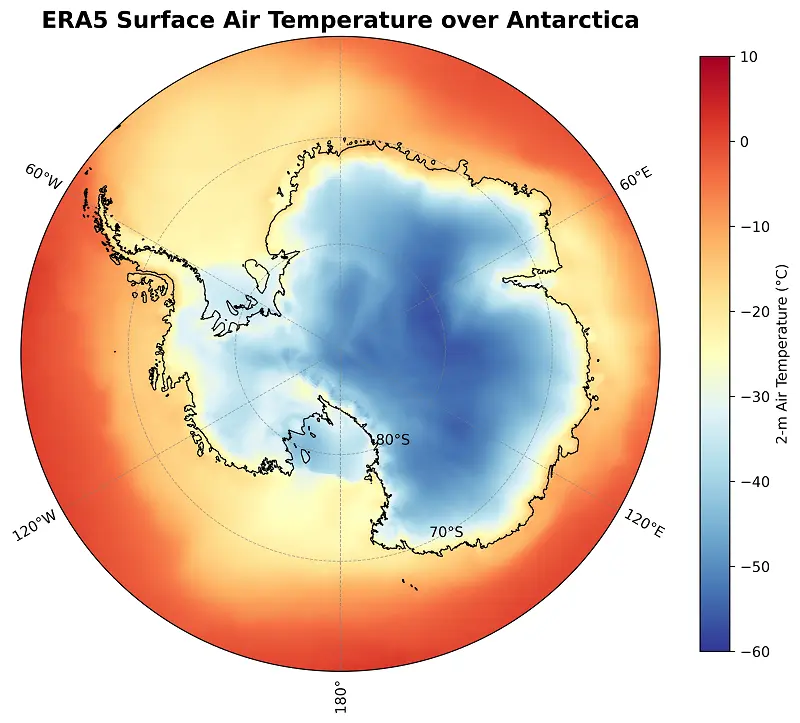
Under the Antarctic Treaty adopted in 1959, Antarctica encompasses all areas south of 60 degrees south latitude, including the Antarctic continent, the Southern Ocean, ice shelves, surrounding waters and islands within this region.
With an area of approximately 14 million square kilometers, Antarctica is one of the largest landmasses on Earth and one of the most important regions for research in climate science, oceanography, atmospheric science, glaciology and biology.
The growing scientific importance of Antarctica has led many countries around the world to establish national polar research centers to expand scientific capacity, train specialists and strengthen international cooperation.
National Antarctic Research Center
The National Antarctic Research Center was established in 1392 at the National Institute of Oceanography and Atmospheric Science with the aim of advancing and coordinating scientific and operational activities related to Antarctica. In 1393, the Center became a member of the Scientific Committee on Antarctic Research (SCAR).
The Center conducts studies in areas including legal and economic aspects, environmental characteristics, and the activities of research stations in Antarctica, while contributing to the development of the country's scientific and operational capacity in Antarctic research.
The Center's principal mission is to develop national scientific capacity for understanding Antarctica, conducting research in the region, and strengthening scientific cooperation at national and international levels.
Main objectives
Scientific research
Conducting research in legal, economic, environmental and scientific fields related to Antarctica.
International cooperation
Participating in international meetings and workshops and developing cooperation with countries operating Antarctic research stations.
Education and human resource development
Developing specialized training and preparing skilled personnel for research activities in Antarctic sciences.
Public awareness and communication
Encouraging the participation of researchers and academics and promoting scientific awareness of Antarctica.
Importance of Antarctic research
Antarctica is far more than a remote icy region. It plays an important role in understanding the Earth's climate system, oceans, ecosystems and long-term environmental change.
Climate change
Antarctic ice preserves valuable information about Earth's climate history. Changes in Antarctica can also influence sea level and global atmospheric and oceanic patterns.
Biodiversity
Antarctica supports unique forms of life adapted to extreme environmental conditions. Studying these organisms provides valuable insight into biodiversity and biological adaptation.
Natural resources
Scientific study of Antarctica's natural resources and geological characteristics is an important research area, subject to international and environmental regulations.
International cooperation
Antarctic research has an inherently international dimension, providing opportunities for scientific collaboration and exchange of data, knowledge, technology and experience.
Scientific and technological progress
The unique Antarctic environment provides exceptional opportunities for advancing scientific methods, developing new technologies and improving research approaches.
Scientific and research achievements
Iran–Russia scientific cooperation
Antarctic Polar Lows and their Role in The Ocean-Ice-Atmosphere System
Operational implementation of Polar-WRF
Operational implementation of the Polar-WRF atmospheric numerical model for Antarctic and polar research.
Scientific publications and studies
Spatiotemporal patterns of polar low activity over the Southern Ocean
Farjami, H., & Kazemi, A. F. (2024).
Journal of Geophysical Research: Atmospheres, 129(4), e2023JD039832.
Assessing the Role of Heat Flux in Polar Low Activity in the Southern Ocean
Farjami, H., & Kazemi, A. F. (2024). Journal of Geophysical Research. (Under review)
Antarctic Wind Field Anomalies and Polar Lows
Farjami, H. and Esmaeili, M. (2023). Journal of Oceanography, 13(52), 64–75.
Cooperation with universities and research centers
Scientific and specialized meetings
Defining research capacities and strategies in Antarctica
The first scientific and specialized meeting was held with the participation of experts in polar research and related fields.
- Launch of the first edition of Journey to Antarctica, the Icy Continent
- Invitation of Arctic and Antarctic researchers and specialists to share their scientific and field experiences
Review of completed and future activities in Antarctica
The second scientific and specialized meeting was held in March 2024, focusing on completed activities and future plans.
Development of strategic structures
Initial steps were taken toward establishing a specialized strategic committee for the development of research activities and consideration of an Antarctic research station.
International activities
Strengthening the country's scientific presence in polar research through engagement with international scientific and professional organizations and participation in relevant programs and meetings.
Challenges of Antarctic research
Research activities in Antarctica involve a combination of scientific, technical, logistical, legal and environmental challenges.
Harsh environmental conditions
Extremely low temperatures, strong winds and severe weather conditions create major challenges for scientific fieldwork.
Limited accessibility
Antarctica's remote location makes the transport of researchers and equipment difficult and requires considerable planning and resources.
Technical and equipment challenges
Research equipment must be capable of operating reliably under extremely low temperatures and demanding environmental conditions.
Legal and international considerations
Activities in Antarctica are conducted within the framework of international treaties, agreements and environmental protocols, requiring careful consideration of the applicable rules.
Environmental protection
The exceptional sensitivity of Antarctic ecosystems requires research activities to be conducted with the highest attention to environmental protection.
Proposed approaches for further development
Development of resilient technologies
Using equipment and technologies capable of operating under Antarctic environmental conditions and very low temperatures.
Expansion of international cooperation
Leveraging cooperation with countries that possess Antarctic stations and research infrastructure.
Detailed logistical planning
Improving planning for transportation, equipment supply, emergency conditions and operational support.
Researcher training and preparation
Preparing researchers for scientific and operational work in the demanding Antarctic environment.
Environmental protection
Applying environmental protocols and international requirements throughout research activities.
Use of satellite data
Using satellite observations to monitor environmental and atmospheric conditions and improve research planning.
Advancing Antarctic knowledge through scientific research
The National Antarctic Research Center seeks to advance the country's scientific activities in Antarctica by building research capacity, educational opportunities and international scientific cooperation.
Contact the National Antarctic Research Center
Center Director: Dr. Hossein Farjami 
Address: No. 3, Etemadzadeh Street, West Fatemi Street, Tehran, Iran
Telephone: 021-66944873, Ext. 289 - 320
Email:
h.farjami@inio.ac.ir