Iranian National Institute for Oceanography and Atmospheric Science to Hold Three Specialized Training Courses in Oceanographic Data and Artificial Intelligence
Iranian National Institute for Oceanography and Atmospheric Science will hold three specialized courses on oceanographic data, AI, and ERA5 reanalysis data from September 4–13, 2026, taught respectively by Dr. Abolfazl Saleh, Dr. Alireza Hakimi, and Dr. Samaneh Sabetghadam.
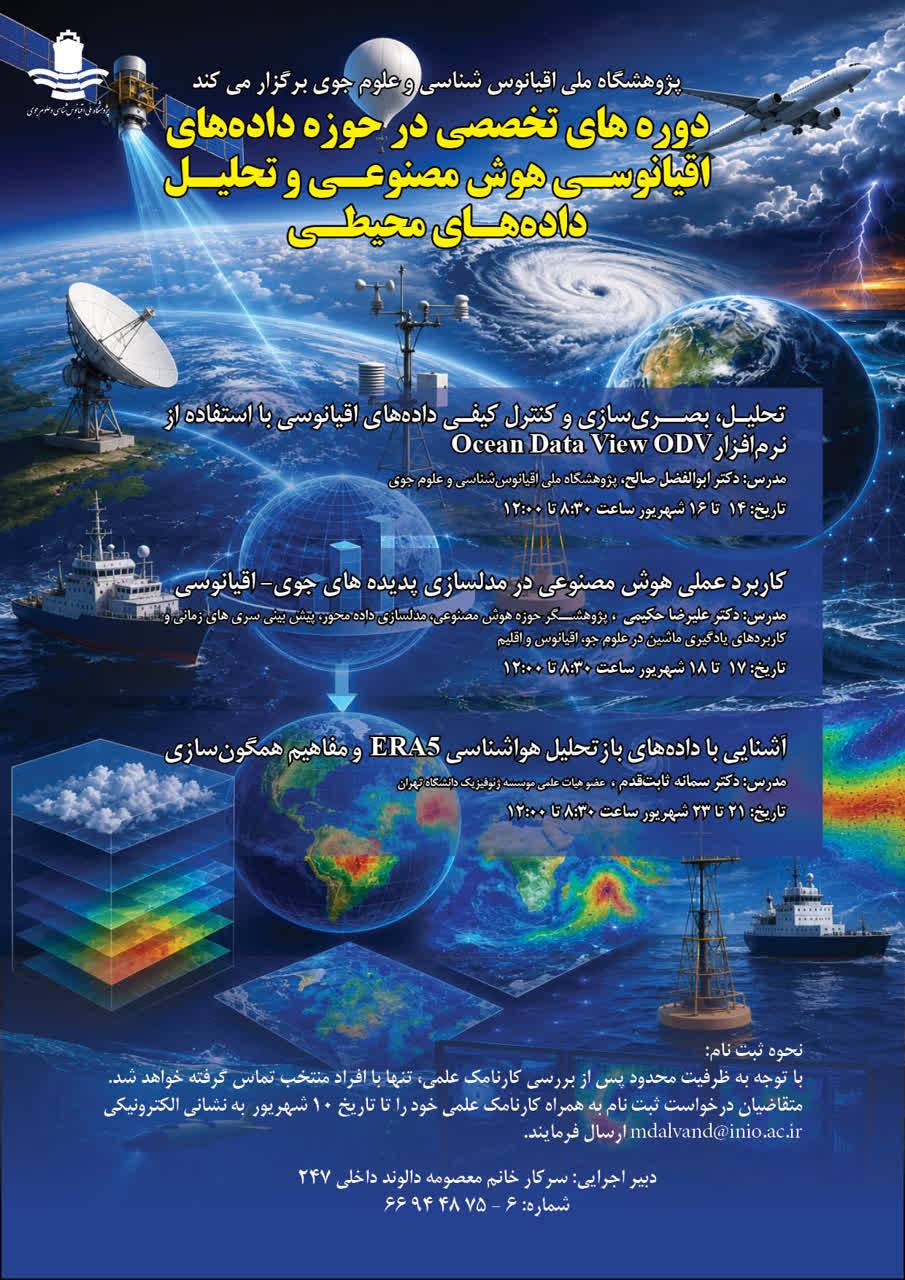
In line with the objectives of the United Nations Decade of Ocean Science for Sustainable Development (2021–2030) to develop scientific capacities and move toward a Digital Ocean, the National Institute for Oceanography and Atmospheric Science (INIOAS), aiming to enhance the skills of researchers, faculty members, graduate students, and specialists in atmospheric and ocean sciences, will hold three specialized and practical courses in ocean data, artificial intelligence, and environmental data analysis from September 5 to 14, 2026, both in person and online (hybrid).
According to the Public Relations Office of INIOAS, these training programs have been designed in line with the global priorities of the Ocean Decade, including the development of data-driven systems, the use of artificial intelligence, the standardization of data analysis, and the provision of the infrastructure needed for the formation of a Digital Twin of the Ocean—skills that are now widely used in ocean data analysis, forecasting atmospheric and marine phenomena, climate research, and the development of intelligent decision-support systems. The first course, entitled “Analysis, Visualization, and Quality Control of Ocean Data Using Ocean Data View (ODV),” will be held from September 5 to 7.
This course will be taught by Dr. Abolfazl Saleh, a faculty member of INIOAS, and participants will become familiar with the management, quality control (QC), analysis, and visualization of ocean data, as well as the practical application of this software in research projects. The second course, entitled “Practical Application of Artificial Intelligence in Modeling Atmospheric–Oceanic Phenomena,” will be held on September 8 and 9. Presented by Dr. Alireza Hakimi, a researcher in artificial intelligence and data-driven modeling, this course will cover machine learning, deep learning, hybrid physics–AI models, preparation of atmospheric and ocean data, and the design of research ideas that can be turned into projects, papers, or practical systems. The third course, entitled “Introduction to ERA5 Meteorological Reanalysis Data and Assimilation Concepts,” will be held from September 12 to 14 and will be taught by Dr. Samaneh Sabetghadam, a faculty member at the Institute of Geophysics, University of Tehran.
In this course, participants will become familiar with the concepts of reanalysis data, methods for accessing and downloading ERA5 data, the NetCDF structure, and the applications of these data in meteorological, climatological, and related studies. These specialized courses are being held as part of INIOAS’s approach to developing specialized human capital and strengthening national capabilities in atmospheric and marine sciences—a field that, in recent years, with the expansion of big data, artificial intelligence, and digital systems, has become one of the requirements for the country’s scientific and executive development. Training in standard ocean data analysis, the use of global reanalysis data, and the application of artificial intelligence in atmospheric–oceanic modeling provide the ground for training experts who can play a role in forecasting and monitoring atmospheric and marine hazards, managing water and sea resources, environmental monitoring, developing meteorological and oceanographic services, and providing scientific support for blue economy policies. This approach, in line with the objectives of the United Nations Decade of Ocean Science, is a step toward strengthening the knowledge infrastructure needed by the country to move toward a Digital Ocean and develop data-driven decision-making in the sea and atmosphere domains.
Given the limited capacity of the courses, registration is carried out by sending a request along with an academic transcript to mdalvand@inio.ac.ir, and after reviewing the requests, selected applicants will be contacted. Those interested in obtaining more information can contact the executive secretary of the courses, Ms. Masoumeh Dalvand, at 66944875-6 (ext. 247).