The presence of the head of the research institute at the international meeting of the Executive Council of the Intergovernmental Oceanographic Commission of UNESCO in Paris
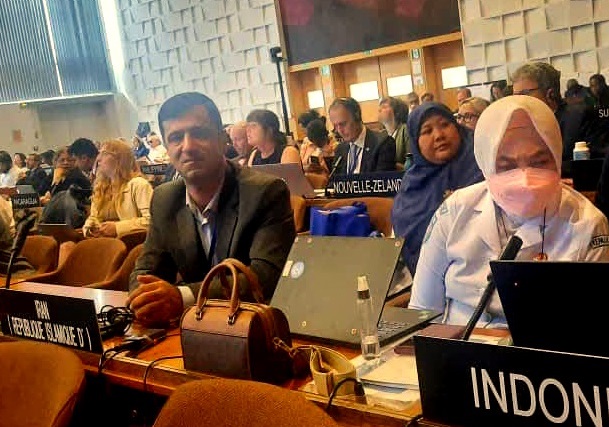
The head of the National Research Institute of Oceanography and Atmospheric Sciences participated in two international events, "32nd Annual Meeting and 56th Meeting of the Executive Council of the Intergovernmental Oceanographic Commission of UNESCO" which was held from June 30 to July 9, 1402 at the UNESCO headquarters in Paris.
According to the public relations report of the National Institute of Oceanography and Atmospheric Sciences, at the beginning of this international meeting, the Intergovernmental Oceanographic Commission of UNESCO (IOC) presented its annual report. Then the opinions of different countries about the decisions were explained and Dr. Morteza Tavakoli, the head of the research institute, as a representative of the Islamic Republic of Iran, while presenting a report on the activities of the Islamic Republic of Iran in the field of marine, oceanic and atmospheric sciences, presented his opinions in this meeting.
It should be noted that in this international event, several meetings were held in which the representatives of the member countries presented their opinions and expert views. The most important of these meetings are:
- IOCINDIO Central Indian Ocean Committee and its status improvement,
- early warning systems of marine hazards,
- IODE marine data management program,
- Revision of oceanic data exchange policy,
-Corrections in IOC status in ocean reports,
- Updating the indicators of goal number 14: life under water (protection of life under water),
-Following the operational plan of the global climate change observation system,
- Developing a new strategy on oceanic planning and management,
- Capacity building strategy,
- Report of regional sub-commissions and committees: African, Caribbean and Pacific and Indian Ocean Committees.
- GEBCO bathymetry and ocean mapping,
-Decade report of oceanic sciences,
- Governance, planning and budgeting.
The election of the presidents and vice presidents of the IOC as well as the elections for the membership of the countries in the executive council of the IOC were among the other programs of these international events, during which Mr. Dr. Yutaka Michida from Japan was elected as the president of the Intergovernmental Oceanographic Commission and 5 vice presidents from France, Bulgaria, Colombia, India, and Egypt were elected as follows.
Marie-Alexandrine Sicre (France) - Electoral Group 1
Nikolay Valchev (Bulgaria) - Electoral Group 2
Juan Camilo Forero Hauzeur (Colombia) - Electoral Group 3
Srinivasa Kumar Tummala (India) - Electoral Group 4
Amr Zakaria Hamouda (Egypt) - Electoral Group 5
Based on this election, the member countries of the IOC Executive Council were elected as follows:
Group 1: Canada, France, Germany, Iceland, Italy, Portugal, Spain, Turkey, Great Britain and Northern Ireland, United States of America
Group 2: Bulgaria, Romania, Ukraine
Group 3: Argentina, Brazil, Chile, Colombia, Costa Rica, Ecuador, Granada, Panama, Peru
Group 4: Australia, Bangladesh, China, Cook Islands, India, Japan, Pakistan, Republic of Korea, Thailand
Group 5: Congo, Egypt, Kenya, Gabon, Morocco, Oman, Saudi Arabia, South Africa, Togo
UNESCO's Intergovernmental Oceanographic Commission (IOC) is considered the most important international institution in the field of ocean sciences. This commission was established following Resolution 2/31 of the 11th session of the UNESCO General Conference and held its first meeting in UNESCO in Paris from October 19 to 27, 1961, and 40 countries became members of this commission in the same meeting. The structure of the IOC consists of the Member States of the Commission and the Executive Council and the Secretariat and a number of subsidiaries, and its Secretariat is located in Paris, France. Currently, 150 countries are members of the IOC, among which 40 countries are members of the executive council of this commission. The meeting of the IOC Executive Council is held annually and the general meeting is held every two years.
The National Research Institute of Oceanography and Atmospheric Sciences is the national authority of the Intergovernmental Oceanographic Commission of UNESCO, and the head of the research institute, as the representative of the Islamic Republic of Iran, actively participated in all meetings full-time and presented his opinions on the issues raised.
