The scientific meeting "explaining research capacities and strategies in Antarctica" and unveiling the book "Journey to Antarctica, Ice Continent" was held.
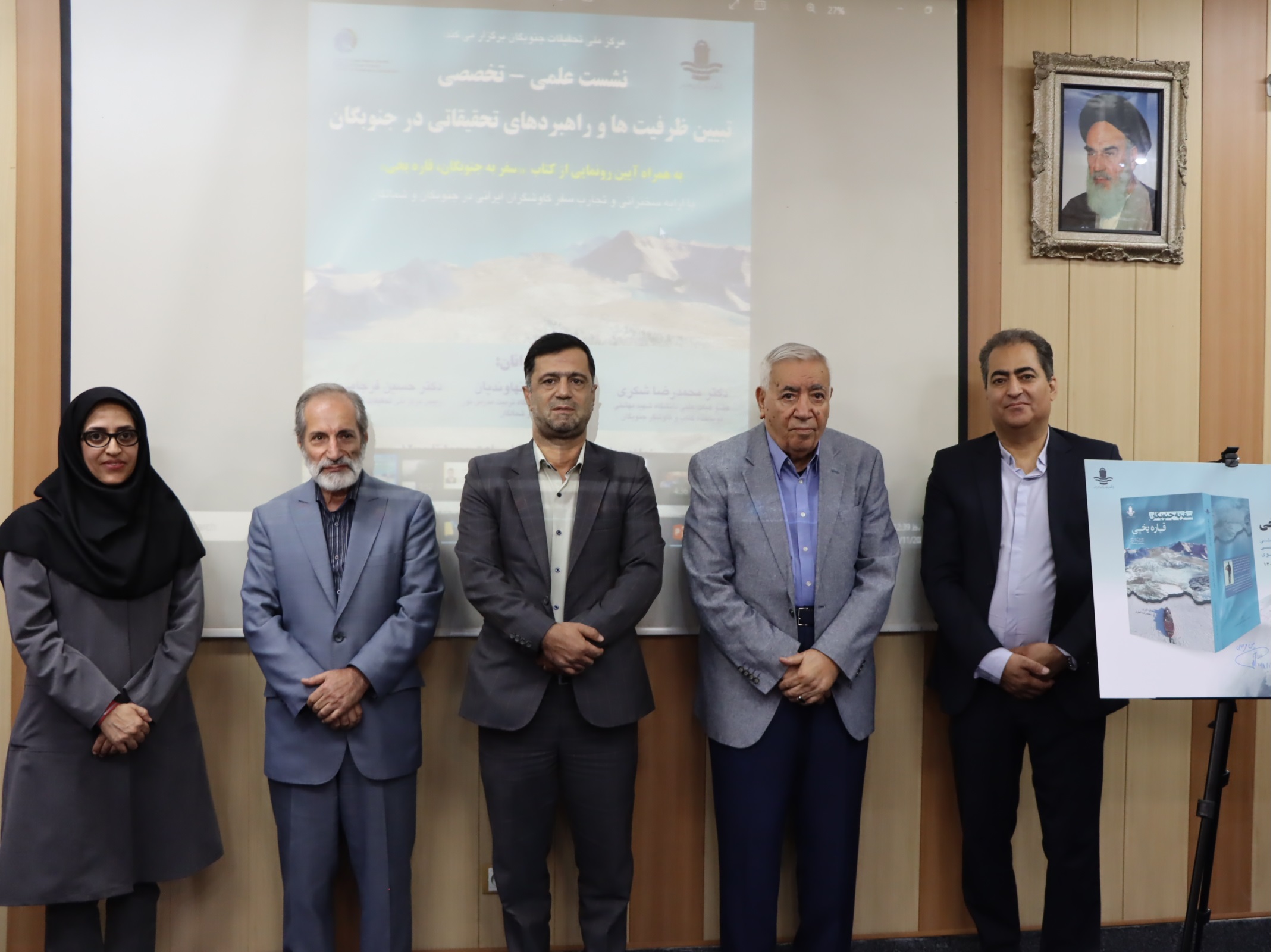
Scientific-specialist meeting "Explaining research capacities and strategies in Antarctica" along with the unveiling of the first book "Journey to Antarctica, Ice Continent" with the presence of Dr. Mohammad Reza Shokri, Shahid Beheshti University faculty member, Dr. Samieh Nahavandian, Tarbiat Modares University faculty member (Iranian explorers who have experienced a research trip to Antarctica and the Arctic) as well as Dr. Morteza Tavakoli, the head of the National Research Institute of Oceanography and Atmospheric Sciences, Dr. Hossein Farjami, the head of the National Antarctic Research Center, university professors and research centers, students and those interested in this topic, on Wednesday, November 10, 1402, in person at the research center and virtual.
According to the research institute's public relations report, at the beginning of this meeting, Dr. Morteza Tavakoli pointed out the importance of Antarctica from various dimensions and stated: National Research Institute of Oceanography and Atmospheric Sciences, as the main center of Antarctic studies, should introduce the areas that can be important for the country and have an increasing role with regard to its scientific capacities. He pointed to the establishment of the National Antarctic Research Center in this research institute since 2013 and noted: This center has faced various ups and downs in the past years and since its establishment.
Tavakli reminded: the research institute has taken steps for research in this field in three basic axes; The first axis is the notification of a resolution to the country's universities to support master's theses and doctoral theses that are written in the field of Antarctica. According to this resolution, master's theses will be financially supported with the amount of 10 million and doctoral theses with the amount of 20 million tomans. He called the second axis appreciation of people who have worked in the field of documenting past achievements and said: Today, Dr. Shukri, the author of the book "Journey to the Antarctica of the Ice Continent" and other active people in this field are being honored. Another axis is holding educational workshops with the presence of veterans in this field
According to the Antarctic Treaty approved in 1959, Antarctica, with an area of more than 34 million square kilometers, includes the entire area south of the 60° latitude of the southern hemisphere, which includes the Antarctic continent, the Southern Ocean, ice sheets, waters and islands located in this area. Antarctica is the fifth largest continent with an area of about 14 million square kilometers, which covers more than 30% of the Antarctic region.
Specialists in international law and political geography believe that the poles of the earth, especially Antarctica (the Antarctic continent and the Southern Ocean) have emerged as the new priorities of global powers for acquisition and political and economic influence in the future of the world.
More than 40 countries of the world have established national polar research centers in their countries due to the understanding of the importance of this region and to achieve the scientific, economic and political interests of Antarctica. These centers operate on very wide scientific fields such as oceanography, atmospheric physics, meteorology, astronomy, glaciology, biology, legal, social and political studies and many other branches of science.
In the second speech of this meeting, Dr. Hossein Farjami considered Antarctica to be the region below the 60 degree orbit based on the Antarctic Treaty in 1959 and added: From a scientific point of view, the boundary between the cold waters of the Southern Ocean and the warmer northern waters is known as the Antarctic boundary. He considered Antarctica as one of the world's continents, which is bigger than Europe, and stated: This continent is the driest continent in the world, which contains 90% of the ice on the planet, which is about 70% of the fresh water on the planet's surface. Also, 98% of it is covered by ice sheets and it is known as the windiest region in the world.
Referring to the importance of this region, the head of the National Antarctic Research Center pointed out that one of the most important features of this region is climate control and global warming. Because this area is due to the exchange of cold and warm waters And strong ocean currents prevent the temperature from rising too much becomes the earth He mentioned paleoclimatology, observation of magnetic storms caused by explosions on the surface of the sun, creation of studies in deep space, tracking of satellites, establishment of monitoring networks and remote control of weapons systems and a rich source of geological, biological, physics and chemical data as other aspects of the importance of Antarctica. Farjami said about the importance of research in Antarctica from the economic aspect: extraction of ice mass, fossil materials, fishery materials, minerals and tourism is important. Also, it is important from various scientific, legal and economic points of view and the acquisition of modern and communication technologies. Referring to the beginning of the work of the International Scientific Committee for Antarctic Research in 1958, he said: the activities of this committee led to the drafting of the Antarctic Treaty by 12 countries in 1959 so that the territorial claims of some countries in this continent remain suspended and other countries can use its benefits for scientific research and peaceful purposes.
Farjami reminded: Different countries can enter the treaty with the approval and organization of this scientific committee, and the only way to enter and accept the treaty is to conduct effective studies, which will first become non-consultative members and then become main members of the treaty after going through various stages. Therefore, continuous activity, effective presence and having a coherent and advanced scientific program in Antarctica is the only way to reach this region. With regard to these goals, Dr. Mohammad Reza Shokri was sent to Antarctica on a three-month mission by the Research Institute in 1377. Referring to the formation of the National Antarctic Research Center in the Research Institute in 1392, he continued: At the same time, the Antarctic Steering Committee was formed by the order of the then Minister of Science, Research and Technology, and in 2014, the Research Institute sent a request to become a member of the Scientific Committee for Antarctic Research, and in the 33rd meeting of the committee in New Zealand, after the investigations, Iran became a member of the Scientific Committee for Antarctic Research. will be
Farjami emphasized: Iran's research program in Antarctica includes laying the foundations and starting research activities along with the establishment of a permanent research base in Antarctica with the aim of benefiting Iran from scientific, economic interests and various projects in the economic and legal fields. The implementation steps for the construction of the research base have been prepared and based on the observation and review of research documents and experiences of other countries, the construction of the base can be done within a 5-year plan. Also, presenting the Antarctic plan to the decision-making bodies such as the Islamic Council and the Expediency Council and including the Antarctic issues in the supported issues. Iran's National Science Foundation (Fund to support the researchers and technologists of the country) is one of the research institute's other actions. He pointed to the institute's joint research projects with other countries and said: A research project with the Russian Nansen Remote Sensing Research Center located in St. Petersburg to investigate the phenomenon of polar low pressures is underway. Also, various training workshops have been held in Iran with the presence of foreign experts.
Dr. Mohammad Reza Shokri, author of the book "Journey to Antarctica, Ice Continent", was the third speaker of this meeting. At the beginning of his speech, referring to his trip to Antarctica 25 years ago as a research mission and some climatic and geographical features of this region, he stated: Only 2% of the edge of the Antarctic continent is free of snow and ice for 2 months in the summer, and most of the research stations were built in this region, which is known as an oasis. The continent of Antarctica has three parts: eastern, western and peninsular.
Shukri, explaining the temperature situation in this region, said: The lowest temperature recorded in the world was 89 degrees below zero, which was recorded in 1983 in the Vostok region of Russia. The air temperature in the oases reaches above zero during the summer and only for one or two hours. He continued: The main problem is the blizzards that blow at a speed of 300 kilometers per hour in this area and cause problems for researchers. Shokri said: Ice caps also move up to a thousand meters a year, scientists usually record this movement, and in recent years due to climate change, the movement of these caps has increased. He explained about the location of the bases: the bases are on the territories It was built free of ice and several stations were built on the ice shield in the early years, which usually faces the risk of destruction, such as the Hindustan base, which was established in 1985 and was destroyed five years later. Antarctic sea ice is usually a problem for the movement of ships, and the Antarctic ice front is regularly monitored by research vessels. Shokri also said about the biodiversity in this region: there are 19 species of birds, 14 species of southern ocean whales, 6 species of jaws, 7 species of penguins and krill shrimp.
Referring to the importance of research in the Antarctic region, the professor of Shahid Beheshti University said: This region is a natural laboratory, it plays an important role in the balance of the world's climate and ocean currents, there are legal and special challenges to be present in this region, and different countries claim ownership in this region, which has caused conflict and competition, and research in this region leads to a better understanding of the environment.
The author of the book Journey to Antarctica, the Ice Continent, referring to the existence of various mines in this region, said: "Coal, hydrocarbon, iron ore, platinum, copper, chrome and uranium exist in this region, but due to weather conditions, limited access and legal protection of mining, mining is difficult, and the environmental protection protocol also prohibits mining activities in this region. Shokri pointed to the history of the discovery of Antarctica by a Norwegian group in 1911 and said: The Norwegian Roald Amundsen went to this area in 1911 and then the English Scott group in 1912. Today, there are 75 stations including 45 permanent stations and 30 seasonal research stations in this region; While in 2006 there were only 40 stations.
According to him, the oldest station in this area was established in 1903, America in 1957 and Russia in 1958 established a base in this area. Shukri enumerated the research opportunities in this region and said: Investigating the effects of climate on fresh water resources, identifying and extracting mineral resources, international cooperation and increasing the level of awareness and developing knowledge and technology are some of the research opportunities in this region. According to the report of the International Antarctic Cooperation Organization, the average cost of building a field base is about $100,000, but studies of the actions of other countries show that the construction and maintenance of such a base costs up to $10 million a year. In the end, Shukri advised that it is better to conduct a lot of research in the form of sending researchers to Antarctica before building the base. Also, considering the superiority of mobile bases over fixed bases, the construction of a mobile base or in the vicinity of other bases should be investigated.
In the continuation of this meeting, Dr. Samiye Nahavandian; In his speech, the faculty member of Tarbiat Modares University stated: Poles play an important role in global warming and maintaining atmospheric balance. Unfortunately, the Arctic is warming at a rate twice the global average, and the polar ice is being destroyed. He continued: Scientists say that the Arctic will be ice-free by 2080, which is very dangerous and will have terrible consequences.
It should be noted that in this ceremony, the book "Journey to Antarctica, Ice Continent" by Dr. Mohammad Reza Shokri was unveiled, and further, the research and research of Dr. Shokri and Dr. Nahavandian, as well as the valuable services and activities of Dr. Mohammad Taghi Zamaniyan and Engineer Hossein Ardakani, veteran professors of the field of atmospheric sciences who have spent many years of their lives studying, researching, researching and teaching in the field of atmospheric sciences, were praised and honored.
In the following, Dr. Abolfazl Saleh, Dr. Abdul Majid Naderi, Dr. Hossein Farjami and Mr. Amin Fazl Kazemi were honored with plaques for their valuable research efforts in the field of atmospheric and oceanic sciences.In the final part of this meeting, a question and answer session was held, during which the attendees and virtual participants, while presenting their opinions, suggestions and experiences, discussed and analyzed the said matters.
This meeting was held with the efforts of the National Antarctic Research Center of the National Institute of Oceanography and Atmospheric Sciences. Its scientific secretary was Dr. Hossein Farjami, the head of this center, and its executive secretary was Mr. Manouchehr Mohammadi.
 |  |
 |  |
 |  |
 |
 |
 |