In a conversation with the Sarmad newspaper, it was stated: We are at the beginning of the path in the field of ocean and sea research and development!
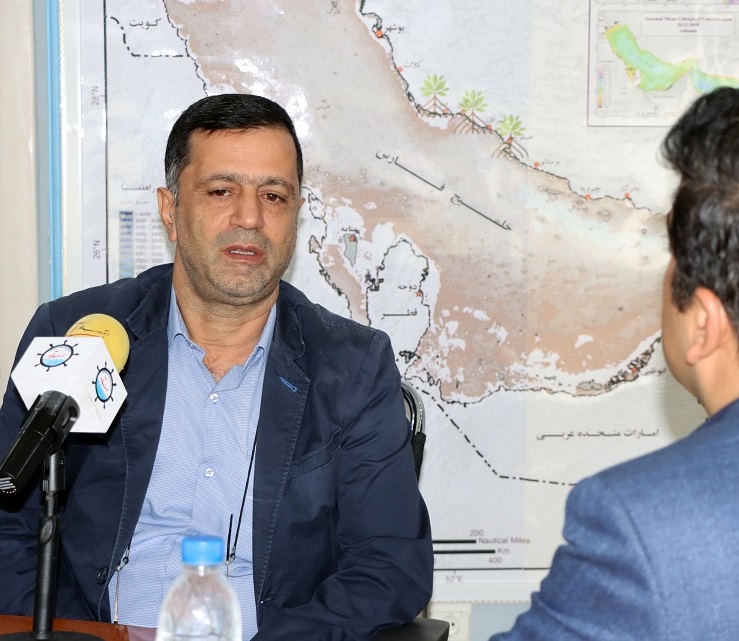
The head of the National Research Institute of Oceanography and Atmospheric Sciences says to "Sermad Marine Newspaper":
We are at the beginning of the path in the field of ocean and sea research and development!
The research institute is ready to provide its experiences and equipment for offshore marine research
is Research and development is necessary to strengthen innovation, advance science and technology, solve social challenges, stimulate economic growth and prepare for the future. By investing in research and development, organizations and countries can put themselves at the forefront of progress and contribute to creating a better and more sustainable world. Considering the importance of the sea for the country, 5800 km from the country's border to the water border, and the majority of the country's trade is achieved through the sea, and the sea and the ocean are related to the country's territorial and food security, the need to know these God-given resources that provide opportunities through research and development is evident, and therefore, the importance of the existence of the National Research Institute of Oceanography and Atmospheric Sciences, which was established in 1370 as the National Center for Oceanography And in 2008, it was changed to the National Institute of Oceanography and in 2012, it was changed to the National Research Institute of Oceanography and Atmospheric Sciences. Considering the importance of this research center and the special movement that has been established after the announcement of the sea-based development policies of the Supreme Leader and looking at the sea-based economy in the country's 7th development plan, in an interview with Dr. Morteza Tawakli, the head of the National Research Institute of Oceanography and Atmospheric Sciences, the role of this research center in the sea-based development programs and the state of research and development in the country's sea-based development were discussed.
Sarmad Marine Newspaper: Please tell me about the role of the research institute and its approach in the country's sea-oriented development plans?
Morteza Tavakoli: The nature of maritime activities requires research and operations to measure various indicators in the sea, which is a very expensive matter. Considering the research institute's mission of conducting marine research in the south and north seas of the country, it responds to national and international needs in the field of oceanography and atmospheric sciences by carrying out programs in the field of research, technology, education, promotion of marine science, research policy and scientific services.
In the 7th plan, the sea-based economy has not been discussed much
It should be clarified that the sea-based economy has not been addressed much in the 7th plan; If more attention should be paid to its various issues from different aspects, because the expectations that exist in the field of sea-oriented development should be more concrete and wider and be more operational. There are many diversity of organizations, functions, roles and abilities in the field of maritime development. As a scientific field of sea-oriented development, according to its mission, the research institute has tried to the best of its ability to obtain the axes that illuminate the horizon of the program.
Sarmad Marine Newspaper: In your opinion, what are the causes of the inconsistency and lack of coordination between the devices and institutions related to the development of the sea?
Morteza Tavakoli: Sea-based development and sea-based economy is a cross-sectoral topic, and various institutions are involved in implementing its parts. If 10 to 20 percent of the power of the relevant institutions is targeted for the advancement of sea-oriented development programs under a common and unified set, the possibility of achieving and accessing concrete results will be easier. What can be considered as a basic gap in this field is the lack of a cross-sector oceanic and marine organization that can help to integrate policies, prevent duplication and common goals based on the program. As the Supreme Leader emphasizes, the sea-based economic sector has the economic growth capacity twice the capacity of the land economy. Obviously, the cost of shipping by sea is much cheaper than by land. Marine farming and marine foods can provide our food security and help the country a lot in terms of energy. And also in the field of medicine and pharmaceutical products and tourism, to be influential and help in the country's economy. Therefore, a cross-sectoral organization is needed to follow up and implement these issues in the form of a joint and coordinated program and to determine and explain their duties to the relevant organizations. Without a doubt, until this consensus and organizational consensus is achieved, we cannot expect much from the development of the sea-oriented and sea-based economy.
It will be very helpful if the "ocean economy" becomes people-based. Another issue in the ocean-based economy is its nationalization. It would be very helpful if people's "economy of the sea" becomes basic. People can have intellectual participation, decision-making and decision-making. Organizations are busy with their tasks, but people are almost invisible. The government economy and all organizations and programs are dependent on government revenues, and due to fluctuations in government revenues, organizations are affected by these fluctuations and this issue is out of their priorities.
Sarmad Marine Newspaper: Referring to trans-sector and strategic management in sea-oriented development is considered an appropriate and technical reference. In countries such as Singapore, England, America, and countries that exploit the sea in the real sense, there is usually a Ministry of Maritime Affairs that directs matters related to the development and economy of the sea. But in our country, this issue has been entrusted to different departments, and the results of the forces have not been put in the same direction. Also, considering that the country is completely maritime and there is a road to the sea from the north and south, the weak credits that are injected into the sea-based programs will not bring good results to the country. One of the main ways to solve the problem that you also acknowledged is the creation of a trans-departmental and governance organization.
Morteza Tavakoli: Considering that 5800 km of sea border, how important and priority is sea tourism; There are good islands in the Persian Gulf, some of which are considered to be part of the country's geopolitical assets, whose national importance can be highlighted only with marine tourism; In the area of underwater heritage, we have a rich civilization in Siraf, Bushehr, Bandar Abbas, etc. that no activity has been done in this field so far. People should much more easily choose their priorities in what field they can operate, we should trust in most cases. The people who live in this land should be trusted in their eyes, in their hard work, in their capital and work. We must provide a platform to prevent the flight of intellectual and material capital in various fields, especially marine. The National Institute of Oceanography and Atmospheric Sciences receives a large amount of funding. Therefore, there is no organizational maneuvering power, and it is difficult to justify the responsible institutions for receiving research expenses related to the missions of the research institute, and only current expenses are considered as budget.
Sarmad Marine Newspaper: Conducting research, especially in deep and international waters, which is sometimes needed by the country, requires funding. In this case, what is your opinion about the development and research department of the country's maritime domain?
Morteza Tavakoli: We are at the beginning of the path in the field of ocean and sea research and development. We have not worked in the field of undersea mines. In various marine and ocean fields, there are many capacities in the country that can be addressed in terms of research and development, but not much work has been done. It is part of our duty that is operationalized by the request of organizations. If we want to do a research work that is strategic for the country, we should go to an organization that has that issue in its field of duties, but due to some contradictions, the work is not done. If we, as a scientific center, should be the place of reference for organizations that come to us for the development of their activities, to research in various fields about the effect of oxygen deficiency in the aquatic environment on food security, or to locate positions for desalination plants and to monitor marine pollution online, such demands are not made from the research institute. to be The research projects of the institute usually come from the creative ideas of our colleagues. Therefore, he goes to the organizations and negotiates a normal project. If it is organized and macro, a project is not considered for the research institute considering that our mission is a strategic mission.
We know that sea and ocean data are very valuable for the country and that this information cannot be sold or a source of income; Because it is related to the administrative areas of the country. Marine data is tied to the territorial and food security of the country and cannot be sold and make the country vulnerable. So this issue is the premise of many valuable actions of universities and research institutes, which should be considered in financial policies.
Sarmad Marine newspaper: What is the reason for the non-referral of institutions to scientific centers such as research institutes to advance their affairs and develop their activities and the country?
Morteza Tavakoli: With inter-organizational interactions, it is possible to use each other's capacities more and benefit more from the national resources available to organizations. But these interactions have not been formed, and the management system of the sector in the country is such that each organization sees its property as the property of its organization only, and does not use it for territorial improvement with the participation and cooperation of others. Every person in an organization has the idea that if he has something at his disposal and has a potential or actual capacity, it should be used in order to secure the interests of that organization and its people only. The research institute with its facilities, equipment, elite manpower and Persian Gulf explorer is ready to provide its equipment for offshore research so that we can add and help to the employment capacity, income capacity and food security of the country.
Sarmad Marine Newspaper: Which executive and public institutions can you cooperate with the most?
Morteza Tavakoli: The production data in the research institute is wide and diverse in nature such as; It has chemical, physical, biological, geographic, environmental and pollution, geological, geopolitical, security and climate change data. We must know the country's threats and opportunities well and study our internal capabilities well. Undoubtedly, one of these abilities is our internal experts, if they are trusted and relied on, many positive things can happen for the country that will not happen to us from foreign experts. We made a 2120 meter harvest, which only 14 countries in the world have this capability. This ability is very vital; Because we made the desired device in the country and gained the experience and special knowledge of it. But is there anyone who wants to use this capacity? The research institute is not a demand creation device, and based on the demand of other devices, it can offer its capabilities and grow. There is this ability that using the experts of the research institute And to work outside the page and the club based on a group and collective work and help in capacity building.
In the field of submarine robots (ROV) we can take important actions, but we need support. And we must have a working and operational arrangement based on the demands that are raised, so that the work goes forward, otherwise the improvisational and continuous actions of this center are the production of science and knowledge. Based on the modified procedure and processes, a path has been tried to be followed so that the research center will be at the top of its field of work and specialization in the long run.
