In Dr. Kabiri's conversation with ISNA, it was mentioned: UAV technology in the service of protecting mangrove forests
New achievement of researchers in the field of environment
UAV technology in the service of protecting mangrove forests/estimating blue carbon without harming nature
An innovative research in the field of environment and technology on the subject of estimating blue carbon in mangrove forests using drone and field data, in the form of a scientific article in an international journal. Forests was published This study, in collaboration with Iranian researchers and relying on non-destructive imaging methods, is considered an effective step in protecting coastal ecosystems and dealing with climate change..
According to ISNA, an article titled "Mapping and Estimating Blue Carbon in Mangrove Forests Using Drone and Field-Based Tree Height Data: A Cost-Effective Tool for Conservation and Management" In the new issue of the international magazine Forests has been published.
This article is the result of the joint collaboration of Dr. Kivan Kabiri, a member of the scientific staff of the National Research Institute of Oceanography and Atmospheric Sciences, Dr. Behrouz Abtahi, a professor at Shahid Beheshti University, and Ali Karimi, a master's student in marine biology..
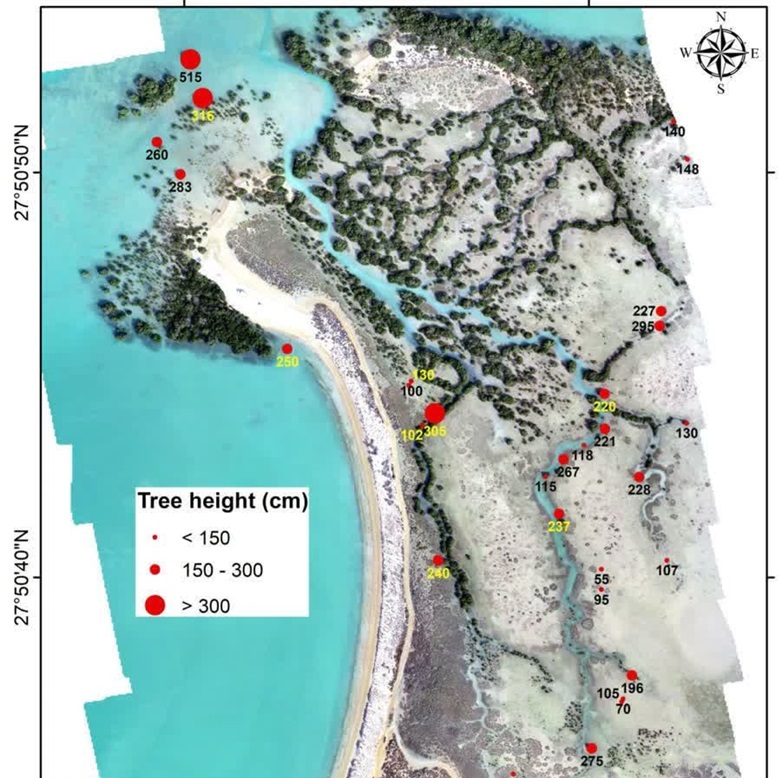
In an interview with Isna, Dr. Kabiri said: In this study, researchers estimated the amount of air pollution by using the data obtained from drone imaging and field measurements. (Above-Ground Biomass) and blue carbon in mangrove species Avicennia marina They worked in "Malganzeh" area near "Mond" protected area in the south of Iran.
The obtained results show that the use of standard commercial drones such as Phantom 4 Pro, together with valid allometric models, allows accurate estimation of carbon stocks of mangrove forests; That too without the need to cut down trees or physically enter hard-to-reach areas.
According to him, this method, as a cost-effective and non-invasive solution, has a high capacity for managing and protecting natural resources..
This research, which was carried out in the framework of Ali Karimi's master's thesis and with the guidance of Dr. Abtahi and the advice of Dr. Kabiri, is a successful example of combining modern technologies with environmental goals and can be a suitable model for similar research in other coastal ecosystems..
This article is open access (Open Access) It has been published and those interested can read its full text through the link below:
https://www.mdpi.com/1999-4907/16/7/1196
According to Isna, "accurate estimation of blue carbon" means measuring the amount of carbon stored in water and coastal ecosystems such as mangrove forests, in a scientific, low-error and reliable way..
blue carbon (Blue Carbon) It refers to carbon that is absorbed by coastal plants such as mangroves, seaweeds and algae from the atmosphere and stored in biomass (such as trunks and leaves) and soil. This carbon plays a very important role in reducing greenhouse gases and combating climate change.
Accurate estimation of blue carbon in this research is important because without destroying the environment or cutting trees, the amount of carbon stored in that area can be measured for areas such as environmental planning and natural resource protection..
If a region has a lot of blue carbon, that means that region is considered a natural reserve to combat climate change, and as a result, preserving that region is considered necessary and valuable from the point of view of the environment..


