In Dr. Kabiri's conversation with ISNA, it was mentioned: Identifying the best areas for artificial rocks in Kish with the help of GIS and fuzzy logic.
A new solution to protect the corals of Kish Island
Identifying the best areas for artificial reefs in Kish with help GIS and fuzzy logic
A new research shows that using spatial information systems (GIS) And the analysis based on fuzzy logic can identify the optimal areas for installing artificial reefs in Kish Island. By considering environmental, biological and spatial factors, this method can reduce the pressures caused by marine tourism and protect the natural habitats of corals..
According to ISNA, a new article about choosing the right place to install artificial coral reefs in Kish Island under the title "A method based on fuzzy logic to choose the place to install artificial reefs - case study: Kish Island, Persian Gulf" With the original title A Fuzzy-Based Method for Artificial Reefs Site Selection – Case Study: Kish Island, the Persian Gulf Recently in Thalassas: An International Journal of Marine Sciences has been published.
This research was carried out with inter-organizational and interdisciplinary collaboration and researchers from the National Research Institute of Oceanography and Atmospheric Sciences, Kish Free Zone Organization, Iran Fisheries Organization and Shahid Beheshti University participated in it..
Dr. Kivan Kabiri, a member of the National Research Institute of Oceanography, in an interview with ISNA, stated: In this study, a new method based on fuzzy logic and geographic information systems was used. (GIS) It is presented to identify the optimal locations of artificial coral reefs around Kish Island.
He stated that the main goal of the research is to reduce the pressures caused by marine tourism and diving on natural coral reefs and to protect these valuable ecosystems and continued: The results of these studies showed that the southeast coast of Kish Island has the best conditions for the establishment of artificial coral reefs due to the favorable combination of medium depth, high water clarity, easy access and suitable biodiversity..
Kabiri pointed out: This study also showed that the areas where similar projects had failed in the past are precisely located in less suitable or unsuitable zones. This shows the high capability of the proposed method to help decision-making in the sustainable management of coastal resources.
This researcher of the National Research Institute of Oceanography and Atmospheric Sciences mentioned: This article can be a scientific model for other sensitive marine areas and shows the importance of effective cooperation between the country's research, management and academic organizations in order to protect the marine environment..
According to ISNA, natural coral reefs in the Persian Gulf and especially around Kish Island are facing many threats caused by natural factors and human activities such as marine tourism. A new research has been conducted with the aim of finding the best places to install artificial reefs in this area.
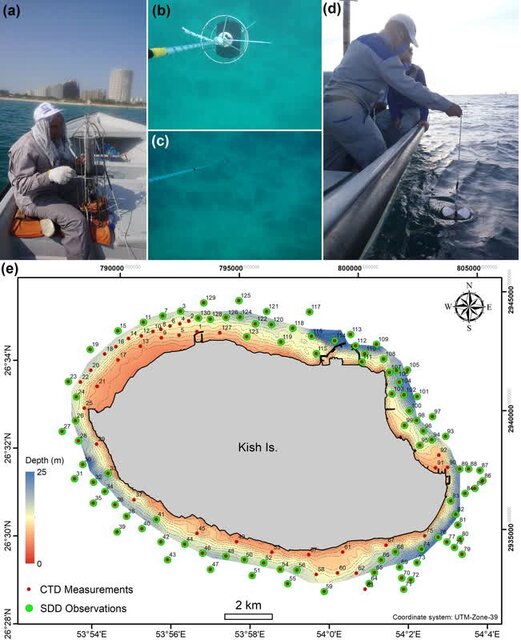
In this study, researchers from spatial information systems (GIS) and used fuzzy logic-based analysis to evaluate several criteria including water depth, clarity, proximity to natural coral patches, and species diversity. Data was collected from various sources, including field observations, existing maps, and high-resolution satellite images..
The results of the fuzzy logic analysis presented a suitable continuous level which was divided into five levels. The southeastern coastal waters of Kish Island were identified as the best areas for installing artificial reefs; These areas have good access, favorable water clarity, medium depth and high biological richness. Also, areas with low ability to install reefs were identified, which was consistent with previous failed projects and shows the effectiveness of this method in local planning..
This research shows that the use of fuzzy logic can integrate diverse environmental, biological and spatial factors in management decisions under conditions of uncertainty. However, the results are based on only one case study in Kish, and more experimental tests are needed to generalize the findings to other marine environments..
This research was prepared by Keyvan Kabiri, Maryam Mohammadi, Hamidreza Bargahi and Mohammadreza Shokri.
Those interested can refer to the following address to view the article
https://link.springer.com/article/10.1007/s41208-025-00919-y
