"The future of coral reefs of the Persian Gulf until the end of the century"
"The future of coral reefs in the Persian Gulf under the shadow of climate change; The results of habitat modeling until the end of the century"
According to the public relations report of the National Institute of Oceanography and Atmospheric Sciences, according to the research conducted by researchers, coral reefs are one of the most important marine ecosystems that have formed in the Persian Gulf under special conditions of high temperature and salinity. The high sensitivity of corals to climate changes and human pressures has doubled the necessity of scientific management to protect this valuable ecosystem and the biodiversity of the region.
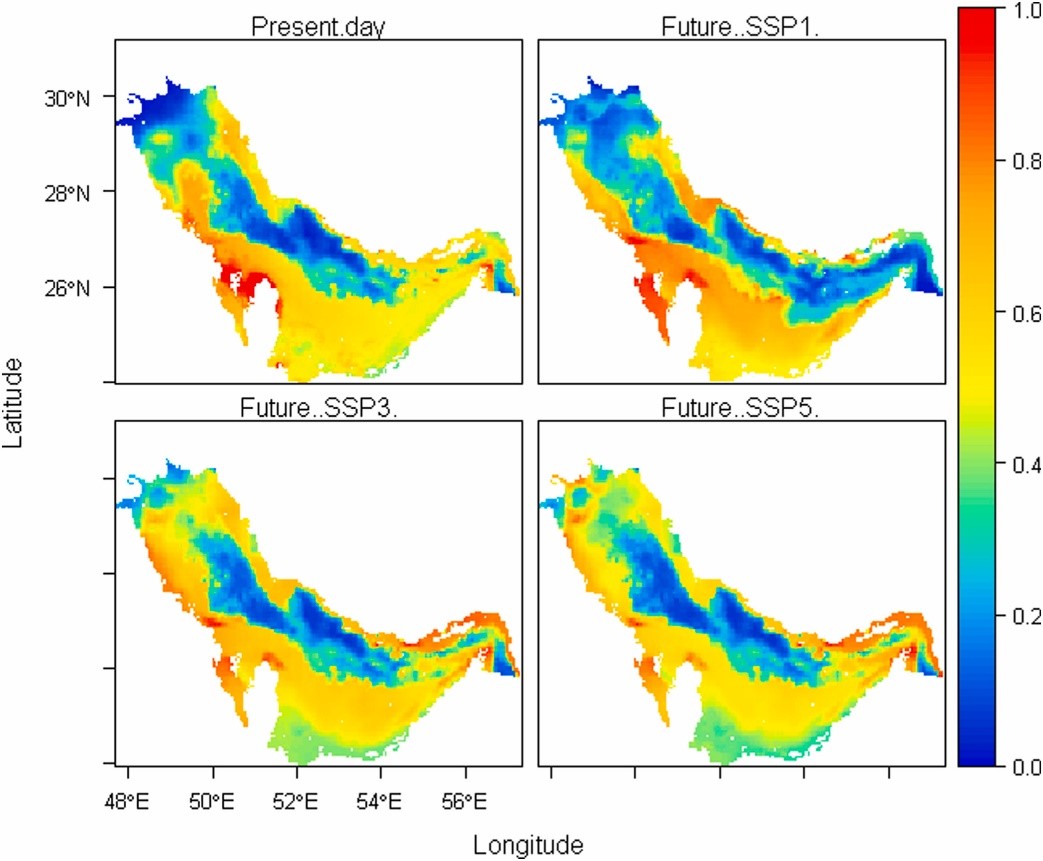
In a recent study, researchers from the National Institute of Oceanography and Atmospheric Sciences using modeling MaxEnt To predict the possible distribution of coral habitats in the Persian Gulf in the period of years 2090 until 2100 They paid These predictions are based on scenarios of common social paths–economic (SSPs) that simulate the possible future of the world based on demographic, economic, environmental and energy consumption trends. scenarios SSP In fact, they are "possible images of the future". Each of them consider different conditions for the world: from a sustainable future with the cooperation of countries and reducing pollution (SSP1), to a challenging world with more consumption of fossil fuels and a sharp increase in greenhouse gases (SSP5). This framework helps scientists to measure the consequences of climate change in different conditions and provide more appropriate solutions for environmental protection.
The results show that based on the water quality indicators, coral habitats in the current conditions can be in an area of about 94 A thousand square kilometers of the Persian Gulf should be present in terms of potential habitat suitability. In the optimistic scenario SSP1 (Sustainability path), this area is slightly reduced and is approx 92 It reaches a thousand square kilometers. scenario SSP3 (Challenge for adaptation) Possible increase of habitats up to approx 14 It predicts the percentage, while in the pessimistic scenario SSP5 (development based on fossil fuels), sharp decline 18 Percentage and fragmentation of habitats is possible.
Dr. Amir Ghazi Lo, the head of this research project, emphasizes that measures such as continuous monitoring, coral restoration, control of human activities, creation of protected areas and education of local communities are necessary to protect this sensitive ecosystem. According to the researchers, the use of scientific data and management based on future scenarios can play a key role in preserving and reviving corals in the Persian Gulf.
This research is an important step towards understanding the future of coral reefs and planning for sustainable development and protection of biodiversity in the region.