With the participation of the National Research Institute of Oceanography and Atmospheric Sciences and the UNESCO Tehran Office, the first training workshop for grassroots people for sustainable development was held in Hormoz Island.
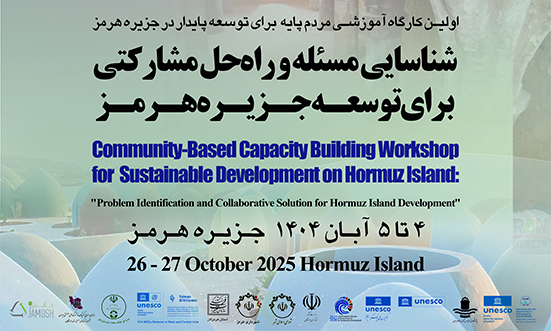
According to the public relations report of the National Research Institute of Oceanography and Atmospheric Sciences, "The first training workshop for grassroots people for sustainable development in Hormoz Island: problem identification and collaborative solution for the development of Hormoz Island" was held with the participation of the National Research Institute of Oceanography and Atmospheric Sciences, the West Asian Oceanographic Research Training Center, the UNESCO Tehran Office, the National UNESCO Commission of Iran, the Hormozgan Governorate and the Islamic Council of Hormoz City and Municipality from 4 to 5 November 1404 in Hormoz Island.
This scientific-educational event was held with the aim of identifying challenges, strengthening local community participation, promoting local capacities, using people-oriented approaches in planning the development of islands, and creating synergy between scientific and executive institutions.
In this event, with the presence of Dr. Ali Mehdinia, head of the National Research Institute of Oceanography and Atmospheric Sciences and head of the West Asian Oceanographic Research Training Regional Center, Mr. Dr. Fartosi, Secretary General of Iran's UNESCO National Commission, Mr. Ying Esrang, head of the UNESCO office in Tehran, Dr. Samad Hamzeyi, head of the Hormozgan Research and Technology Center for Oceanography and Atmospheric Sciences, and Dr. Morteza Tawakli, a member of the faculty of Tarbiat Modares University, along with a group of provincial and local managers, specialists, and Representatives of the local community of the island were held. The problems of the island were identified.
Mr. Dr. Ali Mehdinia, head of the National Institute of Oceanography and Atmospheric Sciences In the opening ceremony, he said about this unique island: "Hormoz Island, as a unique coastal-sea area, is important from two perspectives: first, from the ecosystem aspect, it has a fragile environment and at the same time is rich in marine reserves, geology and special biodiversity. Second, from the human perspective, the host community with valuable local knowledge and potential economic capacities resides in it. This unique ecosystem is affected by the pressures caused by climate change and human activities. Therefore, conventional development models will not be able to provide sustainable solutions without taking into account the active participation of local stakeholders and the integration of indigenous knowledge with modern science.
He continued: "Coral reefs, salt beaches, bird and fish habitats, and sea currents around the island are all parts of a living and sensitive system, the smallest change in which can affect the life and economy of the local people and the beach dwellers, and for this reason, protecting the marine environment of the island is not only a choice, but a vital necessity, and without a proper understanding of the connection between the sea and people's lives, no development model will be sustainable in Hormoz."
Mehdinia noted: "The training workshop for the people on the basis of the development of Hormoz Island was not only an educational meeting, but it is considered a fundamental step in the path of sustainable development, and during its holding, we witnessed a brilliant example of the synergy of scientific knowledge and indigenous knowledge, and we saw how indigenous knowledge, people's experiences, and scientific findings can come together and identify the challenges of an island."
This scientific official pointed out: "The National Institute of Oceanography and Atmospheric Sciences, as a leading scientific institution in the country, and the regional center for oceanographic research training in West Asia, does not see its mission only in carrying out scientific research, but also considers itself committed to promoting marine knowledge and literacy of marine citizens; knowledge that turns people from spectators to helpers in the protection of the sea."
In the opening ceremony of this workshop, Mr. Ying Esrang, head of the UNESCO Tehran office, stated that such programs in the field of UNESCO's missions are in line with its cultural, social and educational goals, and stated: "Hormoz Island is of special importance. In recent years, this island has witnessed a significant growth in tourism and the subsequent improvement of the livelihood of the local community. Of course, this situation has put increasing pressure on the sensitive ecosystems and cultural fabric of the island."
He added: "Hormoz Island is under the influence of indiscriminate exploitation, reduction of biodiversity and waste production, and the training workshop program for the basic people for sustainable development in Hormoz Island has been designed with the aim of cooperation between national and local partners to reduce these damages. This action will be an important step to create new opportunities in Hormoz Island."
Also, Mr. Dr. Fartosi, Secretary General of Iran's UNESCO National Commission, noted in his statement: "Hormoz Island with its rich culture, people and proud history of protecting Iran's land is a part of our national identity. Emphasizing the grassroots approach of the Hormoz Sustainable Development Workshop, he noted: This event is a turning point in the concept of sustainable development, which not only seeks to solve environmental problems, but also seeks to create human and social capacities that play a role in programs with knowledge and self-confidence create."
Fartusi emphasized: "UNESCO is committed to using its capacities to improve the quality of life of the people of Hormuz Island and in this way is fully prepared for continuous and extensive cooperation in promoting sustainable development projects including education, technical knowledge transfer, empowerment of women and youth, responsible tourism and other effective and relevant topics."
In this workshop, Mr. Shahrazad, Deputy Coordinator of Economic Affairs of Hormozgan Governorate, while emphasizing the need to cooperate with the UNESCO office, pointed out the importance of planning and policy making in the tourism sector of Hormozgan Province.
Stating the four tourism sectors of Hormozgan province, he said: "The first sector is backward tourism or land tourism, which has suitable capacities and capabilities for development due to the geographical location of the province." He added: "The second part is coastal tourism, which provides the possibility of developing tourism in this area with the country's longest coastal strip of about 1,110 kilometers."
Shahrazad also mentioned marine tourism and said: "This sector has received less attention, but it has great potential for investment and development." He noted: "The fourth sector is tourism in the islands, which, considering the large number of inhabited islands in Hormozgan province, is the basis for further development in this area."
In this program, Dr. Morteza Tavakoli, a member of the academic staff of Tarbiat Modares University and the educational leader of the workshop, said: "This workshop was designed based on a scientific-participatory framework and its main goal was to identify challenges and issues.
He added: "We hope that the outcome of this meeting will not only improve environmental-social resilience, but also be used as a successful model for other coastal and island communities in the country."
In this two-day workshop, Mr. Dr. Samad Hamzaei, head of Hormozgan Oceanography and Atmospheric Sciences Research and Technology Station, said:" This course is designed to provide sustainable tourism and prevent damage to the island's environment, and we hope to reduce existing problems with more people's participation."
