"Carbon tax" is a way to a sustainable future
A faculty member of the National Research Institute of Oceanography and Atmospheric Sciences, referring to measures to reduce air pollution and thus reduce climate change, said: carbon pricing in the form of a "carbon tax" with the aim of reducing carbon emissions and imposing a fee on the consumption of fossil fuels is one of these measures that different countries have recorded different experiences in this field since about three decades ago..
According to the research institute's public relations report, Dr. Ali Mehdinia considered climate change to be one of the biggest problems and challenges in the present era, and while emphasizing the need for immediate action by governments, businesses and individuals, he said: With the increase in global temperature and the increase in the occurrence of extreme weather events, it is necessary to adopt effective policy measures to reduce greenhouse gas emissions..
He continued: One of these measures is carbon pricing in the form of a carbon tax with the aim of reducing carbon emissions by imposing a fee on fossil fuels based on their carbon content. Carbon tax is a financial mechanism defined to reduce greenhouse gas emissions and to reflect the environmental damage caused by carbon emissions. Intergovernmental Panel on Climate Change (IPCC) It emphasizes the immediate and significant reduction in greenhouse gas emissions to limit global warming 1.5 degrees Celsius higher than pre-industrial levels are essential.
The faculty member of the research institute emphasized: Carbon tax is increasingly recognized as a vital tool in achieving these goals. By making fossil fuels more expensive and carbon taxes on businesses, people are encouraged to adopt cleaner energy options and improve energy efficiency..
In addition, the revenue from carbon taxes could be significant. Governments can use these funds for a variety of purposes, such as investing in renewable energy projects, improving public transportation systems, and supporting communities affected by the transition from fossil fuels. These two benefits of reducing gas emissions and generating revenue make carbon taxes an attractive option for policymakers..
Countries that implemented the first carbon tax
He went on to discuss the history of the implementation of the carbon tax and the leading countries in this field and said: Finland and Sweden are the first countries in the year 1991 They approved and implemented the carbon tax and became a model for other countries. After the adoption of the carbon tax in the year 2008 By Switzerland, some other European countries also started to develop and approve carbon tax with other developed countries; Like Australia and Japan did. For the first time early in the year 2010, carbon taxes were adopted and implemented in emerging markets by South Africa, Mexico and later Chile to achieve climate policy goals. Singapore in recent years with the introduction of a carbon tax in January 2019 made news and became the first Southeast Asian country to do this.
The vice president of research and education of the National Research Institute of Oceanography and Atmospheric Sciences emphasized: This tax is initially in the amount of ۵ Dollars were set for each ton of carbon dioxide equivalent (that is, any business or government or non-government entity that produces carbon as a result of its activity must pay an amount), and to support its net zero goal, a carbon tax was imposed on 25 Singapore dollars per ton of carbon dioxide emissionse2 CO of the year 2024 increased.
The goal is to year 2030 to 50 until 80 Singapore dollars per ton of this kind-of them ۲ COe reach Ireland is also in the budget 2010 (December 2009) introduced a tax called the carbon tax, which is based on the emission of greenhouse gases caused by fossil fuels; It is applied to gasoline, diesel, kerosene and coal. The initial rate of this tax 15 Euro per ton of carbon dioxide that was up to the year 2020 to 20 The euro rose. The Irish government has planned this tax until the year 2030 to 100 Euro per ton to increase to meet its greenhouse gas reduction targets.
He introduced the European Union as the leader in carbon pricing and said: member states of this union, especially through the emission trading system (ETS2) that more than 40 percent of its greenhouse gases, were leaders in this field, and as mentioned, Finland, which emits only three-tenths of the world's greenhouse gases, is one of the pioneers in implementing a carbon tax in the year 1990 was Finland's greenhouse gas emissions per year 2010, ranking among all countries 59 earned the Finland's carbon tax law in 1997 و 2011 It was modified in the year 2013 This tax is a combination of carbon tax and energy tax and its cost 18.05 Euros per ton of carbon dioxide. Finland in the year 2018, the carbon tax to 77 Dollars per ton of carbon dioxide equivalent changed and now approx 60 The euro per ton of carbon dioxide aims to reduce emissions at the same time as economic growth.
EU Emissions Trading System prices since the beginning of the year 2022 to about 85 The euro per ton has increased, reflecting the EU's commitment to achieving reductions 55 Percentage of greenhouse gas emissions up to the year 2030 relative to year levels 1990 is.
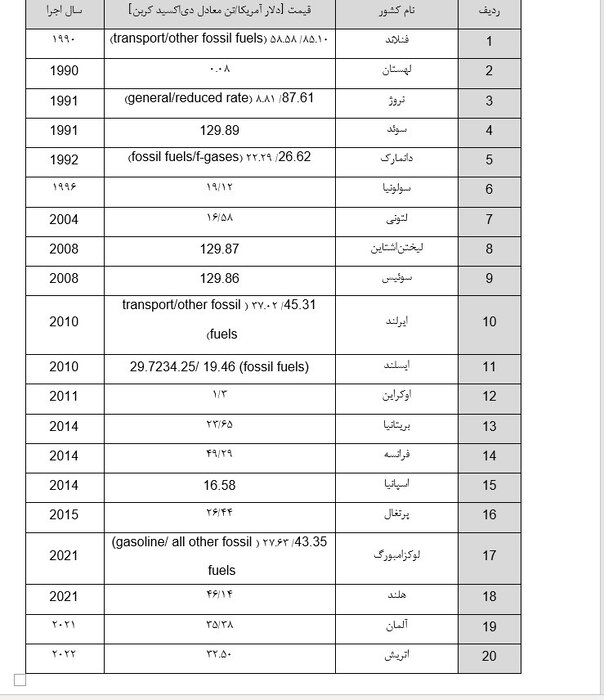
The price of carbon in different countries of the European Union and the years of its implementation
Referring to America's actions, he said: Carbon pricing in America is implemented at the state level, and California has a comprehensive program known as cap and trade. Cap-and-trade2 is leading This program covers several sectors and its goal is to effectively reduce gas emissions. Washington state also has another program called cap and invest cap-and-Invest2 of the year 2023 has started almost 32 A percentage of US greenhouse gases are subject to some form of carbon pricing, although there is no nationwide carbon tax.
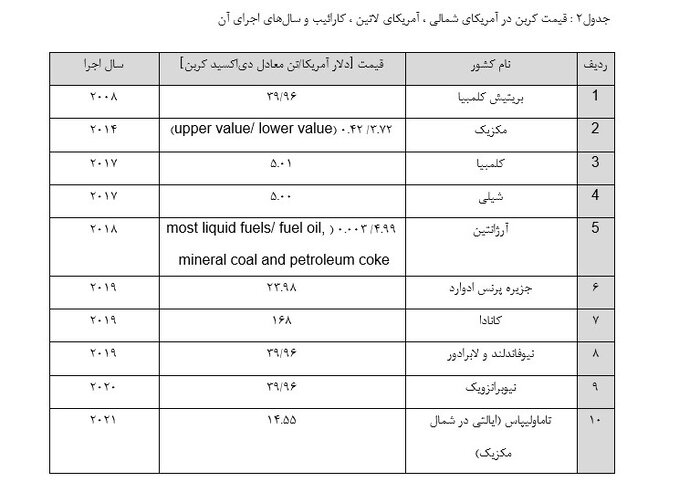
Carbon price in North America, Latin America, Caribbean and the years of its implementation
But in Asia, carbon pricing initiatives are diverse, Mehdinia continued. In recent decades, due to rapid economic development, China has increased its energy demand and has become the world's largest producer of carbon dioxide. in the year 2016، 23.3 The percentage of global emission of greenhouse gases belonged to this country. The Chinese government has announced voluntary reduction targets that include reduction 60 until 65 Carbon intensity percentage up to 2030 and decrease 18 Carbon intensity percentage and 15 Percentage reduction of energy consumption per unit of GDP up to 2020 will be.
According to him, India has not yet implemented the official national carbon tax; But it is considering various legislative measures to reduce emissions through renewable energy initiatives. The complexity of India's economic landscape poses challenges for widespread adoption of carbon pricing mechanisms.
He emphasized: Indonesia as one of the signatories of the Paris Agreement2016), is implementing a carbon tax. This country plans to year 2030 Your carbon emissions 29 The percentage will decrease and is trying to increase the year 2016 To reach the goal of reducing the production of pollutants to zero. Carbon tax in Indonesia by law 2021 Coordination of approved tax regulations and for each extra kilogram of carbon, 30 One thousand rupees (approx 2.1 dollars) is taxed.
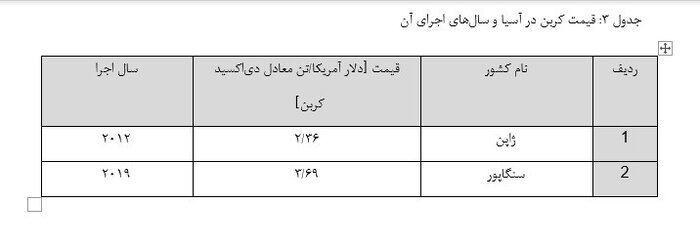
Carbon price in Asia and the years of its implementation; photo
The faculty member of the National Institute of Oceanography and Atmospheric Sciences went on to discuss the approach of governments in the field of carbon and said: Governments are increasingly using the carbon tax as a tool to reduce greenhouse gas emissions and finance environmental projects..
One of these approaches is the application of tax change packages. In this approach, other types of taxes, such as income tax, are reduced in order to avoid increasing tax pressure on different classes of society. The Finnish government has chosen this approach for carbon tax revenues. Sweden has used the revenue from the carbon tax to reduce taxes on workers, which has helped increase employment and improve the economic situation of households..
He added: Governments can invest in green and renewable energy projects using the income from the carbon tax. This approach helps to reduce greenhouse gas emissions and promote economic sustainability. Supporting low-income households is another use of carbon tax revenue. This revenue can be used to support low-income families when prices rise, and governments can use carbon tax revenue to reduce budget deficits and finance public spending. This action can help economic stability and better management of financial resources.
Mehdinia emphasized: Carbon taxes, as a key tool in climate policies, play an important role in reducing greenhouse gas emissions. These taxes not only encourage investment in renewable energy and clean technologies, but also help reduce pollution and generate revenue for governments that can be used to finance environmental and social projects..
He said: Despite this, there are also challenges. Among these challenges are economic impacts on fossil fuel industries and social justice concerns for low-income groups. The US has taken action at the state level, while Europe is leading the way in implementing strong carbon pricing mechanisms. Asian countries such as China are also developing their markets, but face challenges to scale effectively. Carbon trading acts as a complementary mechanism to the carbon tax, allowing companies to buy and sell emission permits, leading to lower costs and increased flexibility in emissions management..
Mehdinia clarified: Despite this, price fluctuations and administrative complications may create challenges that require careful monitoring. To achieve environmental goals, carbon tax rates should be adjusted to have a significant effect on reducing emissions. Also, the distributional effects of these taxes should be taken into consideration and measures should be taken to compensate for the negative effects on low-income groups. A combination of policies including carbon tax, carbon trading and investment in green infrastructure can be more effective than using a single instrument..
In the end, he mentioned: increasing public awareness about the benefits of the carbon tax and its effect on reducing greenhouse gas emissions can also increase public acceptance. Different countries should share their experiences on carbon taxation and carbon trading to identify and implement best practices. Finally, adopting a comprehensive and coordinated approach to carbon taxation and carbon trading is necessary to balance economic impacts with environmental benefits. Technological advances will also play an important role in this field.